January 23, 2026
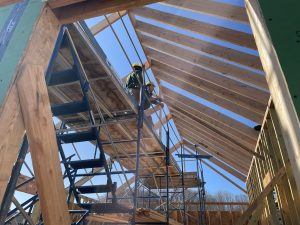
Students stand on scaffolding to frame a roof on the e-house at Eli Whitney Tech. The e-house is a high-performance, energy-efficient home built by students to showcase sustainable construction practices while preparing them for careers in the skilled trades.
At CTECS, academic learning does not stop at the classroom door; it continues in trade shops and job sites every day. Our students routinely apply academic concepts in real-world settings, demonstrating knowledge in ways that are often more complex and enduring than what standardized assessments alone can capture.
An HVAC student calculating load requirements applies geometry and algebra. An automotive student diagnosing engine performance relies on physics and data analysis. A manufacturing student interprets technical drawings requiring spatial reasoning. These applied experiences reflect rigorous academic engagement that mirrors workforce expectations.
While state assessments remain an important measure, they do not always reflect the full scope of what CTECS students know and can do. Many learners demonstrate academic mastery through application, problem-solving, and technical execution, skills that are essential to both career success and postsecondary education. In the 2024–25 school year, students earned 16,424 industry-recognized certifications, validating the skills they have mastered and demonstrating readiness for both careers and further education.
CTECS continues to strengthen the connection between academics and trades so that students clearly understand how academic skills enhance the work they are passionate about. This ensures students graduate academically prepared to pursue a career, higher education, or both, building critical thinking, quantitative reasoning, literacy, and problem-solving skills essential for success in technical fields and lifelong learning.